An oversized window is a measuring and approval problem before it is a cutting problem. If one sheet will fit, confirm the exact film and roll before promising it. If it won’t fit, the customer should see what the seam looks like before the order goes in.
Measure the glass you will actually film
Record the exposed glass, not the frame or the drawing dimension. For a rectangular pane, measure width at the top, middle, and bottom and height on the left, center, and right. Note anything that limits access, from a deep return to a fixed counter. Use enough cut allowance for the approved method; don't assume that a roll marked with the same nominal width as the pane has enough usable film.
Check both orientations before adding a seam
Compare the cut required across the roll with the usable width of the exact product. Then check whether the manufacturer permits rotating the cut. Directional decorative products need special care, and crew handling and the route into the room still have to work. Check that the setup can support a piece that wide and that the crew can reach the cut and liner without stretching across an unstable setup. A wide-format product only solves the job if it also suits the glass and gives the customer the look they approved.
Worked example: a 96 by 68 inch storefront lite
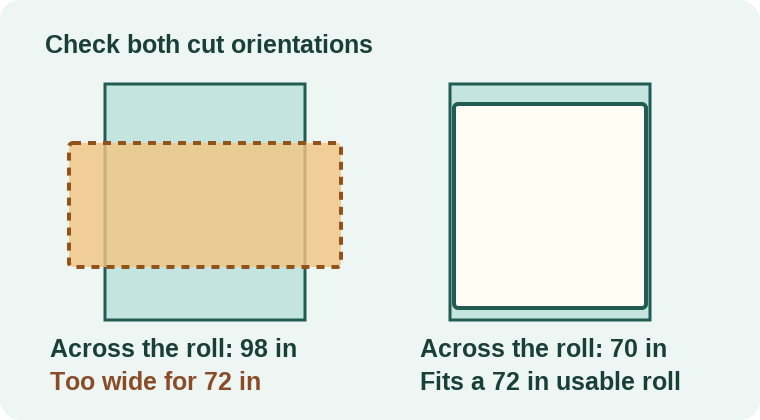
Suppose the verified usable roll width is 72 inches, and the planned cut needs 1 inch extra on each edge for this job. With the cut turned, the 70-inch dimension fits across the roll and the 98-inch dimension comes off its length. That gives a one-piece option if the film allows that orientation and the crew can safely handle it. On a 96 by 74 inch lite, the two cross-roll options are 98 and 76 inches. Neither fits the same roll. These allowances are illustrative, not a product instruction.
If the seam is necessary, show it and write it down
- Verify the product rule. Ask whether a seam is allowed, what joint detail applies, and whether any warranty or performance claim changes. A method in one bulletin does not carry over to another film.
- Show the joint. Use the proposed material and compare it from the primary viewing position and from any angle where the customer regularly sees the glass. Look at it in the room’s normal lighting, not just on a workbench.
- Make the decision traceable. Put the location, direction, approximate distance from a fixed edge, and mockup approval in the quote. If the finish must be seamless, present a verified alternate or decline that pane.
Avery Dennison gives a particular joint detail for its exterior XTRM series. 3M’s flat-glass warranty says spliced film may not meet its specifications and does not warrant performance on applications with splices. For safety or security film, do not assume that a spliced system performs like an unspliced one; obtain approval for the specified assembly before proceeding.
Copy this into the job file
Opening ID: ____ · Exposed glass W × H: ____ · Planned cut W × H: ____ · Exact film and verified usable roll width: ____ · Rotation approved: ____ · Seam allowed and coverage confirmed: ____ · Mockup and location approved: ____
Sources & scope
Use the linked originals for current provider requirements. These links do not imply affiliation, endorsement or project approval.
- Exterior XTRM installation bulletinProduct-specific joint detail for exterior XTRM film. Do not apply to other film systems.Source checked . This is our check date, not a publication date.
- Flat-glass film and attachment warranty exampleProduct-specific claim terms and professional removal guidance.Source checked . This is our check date, not a publication date.